
Why “Dr-45” Isn’t Always Enough – How Door and Vent Design Define Real-World Sound Isolation –
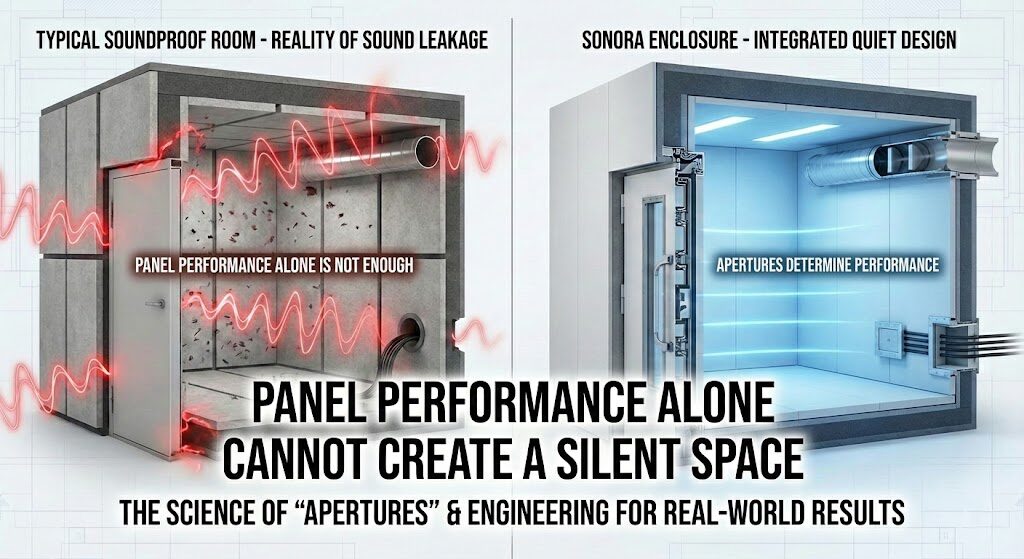
◆ Panel Performance Alone Doesn’t Ensure Quietness
In soundproof room design, specifications like “Dr-45” or “STC 45” are often used as indicators of acoustic performance.
But in practice, even high-grade panels may fail to deliver target NC levels due to unexpected noise intrusion.
The most common source of this failure?
Openings.
Doors, ventilation ducts, and cable penetrations often become acoustic weak points in the system.
◆ The Misconception About Soundproof Doors
A door’s sound isolation performance isn’t determined by thickness or weight alone.
True acoustic control requires attention to structural and dynamic details, including:
| Design Factor | Description |
| Seal Integrity | Poor gasket or magnetic seals allow air and sound leakage |
| Panel Flexing | Door leaf resonance transmits structural vibration |
| Frame Resonance | Improper coupling creates frequency-specific leakage |
| Latch Strength | Insufficient closure pressure weakens door sealing |
At Enclosure, we use mechanically sealed high-performance acoustic doors based on Sonora’s chamber engineering.
This ensures low-frequency control, high airtightness, and reduced flutter or vibration resonance.
◆ Ventilation: A Hidden Challenge in Quiet Room Design
Ventilation systems are essential—but they create direct air paths between the quiet room and outside.
If not designed properly, they become major sources of aerodynamic and structural noise.
Key elements for quiet ventilation include:
| Requirement | Design Strategy |
| Flow Velocity Control | Oversized fans cause turbulence and wind noise |
| Internal Sound Absorption | Ducts must include BFP modules or lined silencers |
| Path Bending (Baffles) | Straight-through ducts allow sound leaks; bends and chambers disrupt transmission |
| Anti-Vibration Mounting | Direct contact with structure transmits vibration |
Enclosure ventilation systems incorporate integrated silencers, acoustic baffles, and airflow control designed for NC-compliant acoustic environments.
◆ Minor Gaps Can Break the Entire Acoustic Design
Common yet underestimated paths of sound leakage include:
- Lighting, power, and cable ports
→ If left unsealed, these create uncontrolled air and sound leaks - Floor–wall interface joints
→ Even a 1–2 mm unsealed edge can result in significant leakage - Panel joints or gaps
→ In-field assembly deviations often lead to measurable NC overages
At Enclosure, every opening is designed with explicit acoustic performance targets and detailed sealing instructions at the architectural level.
◆ Summary: Acoustic “Finishing” Is Done at the Openings
High-grade panels are important—but if door and vent structures are overlooked,
your space will not meet ISO 8253, JIS T 1201, or NC compliance requirements.
That’s why Enclosure delivers fully integrated systems—not just panel kits.
Our designs cover doors, ventilation, electrical ports, and joints, ensuring verifiable silence from edge to edge.